Tuesday, January 31, 2023

How To Remove Radioactive Particles From Water In Case Of A Nuclear Fallout


Although the threat of full-scale nuclear war is low, there is always the possibility that we might end up with radioactive fallout in our drinking water.

An overseas regional nuclear exchange, nuclear accident, reactor explosion or meltdown, or a dirty bomb can all contaminate our water.

There are many filters available on the market that claim to remove 99 percent of radioactive particles, but the truth is that no one filter will remove all the particles from drinking water.

Disclaimer: This article is for interest and information purposes only.

What Types Of Radioactive Particles Might Be In The Water?

There are hundreds of radioactive particles that fallout will deposit over the land and in our water. Some of them will be short-lived, while others will remain in the environment for many years.

Of the multitudes of potential isotopes we may find in fallout, strontium-90, cesium-134, cesium-137, and iodine-131 are of particular concern.

Strontium-90

This is more a concern in the fallout from a nuclear detonation rather than a meltdown or nuclear accident.

The problem with strontium-90 is that its half-life is 29 years which means that it can remain in the environment for hundreds of years before it decays to a point where the danger is negligible.

Strontium-90 can cause bone cancer and leukemia in people who consume contaminated food or water.

Cesium-134 And Cesium-137

Cesium-134 and Cesium-137 have half-lives of 2 and 30 years, respectively.

They are found in fallout, and if people are exposed to them, they can suffer from acute radiation sickness and possibly increase their cancer risk.

Iodine-131

This isotope has a half-life of only around eight days but has serious adverse health consequences for those exposed to it in nuclear fallout.

Iodine-131 will accumulate in the thyroid, potentially leading to thyroid cancer or Thyroiditis.

Many more isotopes can be found in water and food after exposure to fallout, but they are far too numerous to list here.

Filtering Radioactive Particles From Water

Three methods have been shown to filter most radioactive materials from water effectively.

However, no one filter will remove every radioactive particle, so if you want to set up a system to decontaminate drinking water after a nuclear detonation or accident, it is best to have all three on hand.

Even if you have a well-thought-out and secure water storage system in place, you will need to consider how you will supplement your water storage with rainwater. Here’s a guide on how to create an ingenious rainwater harvesting and purification system capable of storing 165 gallons of water.

Reverse Osmosis
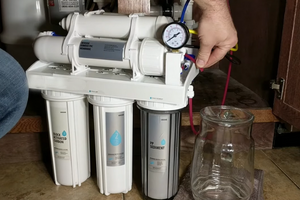
How To Remove Radioactive Particles From Water In Case Of A Nuclear FalloutThe EPA recommends reverse osmosis to remove many radioactive materials from water. It can remove 99% of uranium, radium, alpha or beta particles, and photon emitters.

Reverse osmosis will not, however, remove gaseous contaminates such as radon.

In addition, Idoine-131 will not be filtered by reverse osmosis because it is an isotope that, when found in water, is a dissolved gas.

Reverse osmosis works by pushing water through a semi-permeable membrane. The water which passes through to the other side of the membrane is clean and mostly free of contaminants.

These systems usually employ several filtering steps to filter out and remove particles of differing sizes. Dissolved gasses, however, will find their way through the pores of the filter membrane.

Reverse osmosis filters are widely available and can even be installed in a home to filter water throughout the house.

With these filters, however, there is a problem of what to do with the contaminates that have been filtered out.

Systems designed for your entire home use a large portion of the water to wash away the waste through your household drains and into the sewer system.

In the case of radioactive fallout, you will be left with radioactive wastewater; in portable systems, you will be left with a wastewater tank to dispose of.

Ion Exchange

Ion exchange filters are often sold as water softeners, and they work by passing water through resins that contain positively or negatively charged ions.
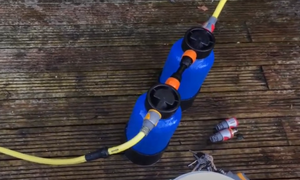
How To Remove Radioactive Particles From Water In Case Of A Nuclear FalloutThese ions essentially swap places with the contaminants in the water.

This is a dramatic oversimplification, but the basic idea is that the particles we do not want in our water are trapped in the resin filter media when safe ions replace them.

Unfortunately, ion exchange filters are not particularly good a filtering out viruses and bacteria or other bugs that can make us sick, so they are not suitable for a stand-alone water purification system.

Ion exchange has been found to be particularly useful in filtering our Cesium-137 but is also effective against uranium, radium, as well as alpha and beta particles.

Ion exchange has the same downfall as any other filter, where you will be left with filter resins that are now contaminated with radioactive particles.

Activated Carbon

Activated carbon filters absorb contaminants as the water passes through the filter.

How To Remove Radioactive Particles From Water In Case Of A Nuclear Fallout

The problem with these filters is that once they reach their absorption capacity, they will no longer remove any particles.

Evidence suggests that carbon filters effectively remove radioactive fallout from our water.

Still, as with all filters, they will not remove 100 percent of the radioactive particles.

Some reverse osmosis filter systems will also include an activated carbon stage within the filter. However, it would still be a good idea to have an external one as a redundancy.

As with other filters, once an activated carbon filter has reached capacity, it will be full of radioactive fallout, which needs to be disposed of appropriately.

What Filter To Use

The best way to filter radioactive particles from your water after an attack or accident is to develop a system that uses all three filters.

You could start with an activated carbon filter to get most of the particles, followed by an ion exchange filter to soften the water and remove some missed particles, then complete the process with a reverse osmosis filter.

Regardless of how you set up your system, you will need extra filter media for each filter and a method to safely dispose of the waste.

Food and water security will be a paramount concern after any nuclear incident, regardless of what it is.

The most crucial thing to consider is establishing your fi

Monday, January 30, 2023

The Ukraine War is Now a War Where There Can Be No Winners. For Putin, Whatever His Original Goals for the War, the Continuation in Fighting is Now Essentially About Regime Survival. Even if the Costs of the War Continue to Grow

The war is now in its ninth month and has a long way to go, it isn’t remotely over.

In other words, the beginning of 2023 in the Ukraine looks a lot like 2022.

It has triggered a global energy crisis and supply chain problems that have halted post-pandemic recovery in many poorer countries.

The war has evolved into one of attrition, grinding on with no end on the immediate horizon.

Putin’s idea that was, the Ukrainian population would either accept their fate as a Russian colony or perhaps even welcome it, is a farcical as Hitlerism vision of a fatherland.

The fighting in Ukraine is effectively now divided into two theatres:

The Donbas region in the east, much of which Russia has captured, where Ukrainian forces are seeking to slow Russia’s advance, and the south, where Ukrainian forces are preparing to launch a counteroffensive to recapture lost territory, with a possible renewed Russian offensive in the east.

At the moment, though, that path seems firmly closed off with the arrival of German manufactured tanks, and American tanks promised if they are supplied in the near future.  

If the Ukrainian counteroffensive succeeds, Putin could come to deem the cost of victory in the east too high. 

If the counteroffensive fails.

A failed offensive that ends in a retreat would be disaster for Ukraine, leaving it militarily weaker and more diplomatically isolated come spring.

Alternatively, Ukraine could become a victim of its own success.

If its forces encroach too far on what Russia may soon officially designate its own territory in the Donbas, Putin could retaliate by using low-yield nuclear weapons, which are designed to be used on the battlefield.

So should a Ukrainian offensive roll over this new self-declared border, the use of nuclear weapons to break up the attack will be on the table. This is not unthinkable — it is only unpalatable.

Nuclear explosion

The Kremlin’s possession of nuclear arsenal means no one can force it to stand down without total annihilation 

If anything we are closer to the war spreading.

Short of  annihilation this is no longer just a question of who beats whom. 

The war asks, how much are we willing to tolerate the unchecked and aggressive use of force, particularly across national boundaries by bigger powers.

However reconsidering the West role in the democratic world after its messy and chaotic exit from Afghanistan.

Inevitably this will mean serious reflection at its (ongoing) history of propping up dictators and turning a blind eye to human rights abuses in the name of diplomacy.

For the war to truly end and for peace to be stable, there has to be some change in Moscow.

The quickest and least bloody path to ending the conflict runs through a settlement negotiated by both sides.

At some point the supply of Western weaponry will dwindle.

Putin’s willingness to escalate and target civilian infrastructure, shows that his all or nothing attitude has not abated.

Remember that he has other, less risky means of terrifying Ukraine and intimidating the West. Chemical weapons.

Putin has made it clear that Russia has no intention of retreating. 

Someone is dreaming or receiving the wrong message that events suggest the war is over. I’ve seen nothing to indicate that any administration has any war termination policies other than the problem is that much of the discussion has relied on a series of unstated and unexamined assumptions about war termination and escalation.

Scrutinizing these assumptions, however, reveals two conclusions.

First, Russia does have a plausible path to victory in the conflict, and will likely prevail absent a significant increase in Western military assistance. Second, the Russians do not have an effective counter to increased Western aid to Ukraine.

If we accept this line of argument, it seems clear that absent a significant increase in outside support for Ukraine—minimally, a dramatic increase in supply of military equipment, but more likely some sort of direct intervention in the form of a peacekeeping mission or imposition of a no-fly zone—Russia will ultimately prevail.

The challenge, however, is to control escalation to avoid the possibility of, in the worst case, a general nuclear exchange. The fear i seems to be that Russia will escalate the conflict, either in intensity or geographic scope in response to an increase in aid or direct intervention.

But why do we think this would be the likely Russian response? 

Russia could escalate to nuclear weapons, of course. But to what end? Can Russia win a nuclear exchange?

It is difficult to construct a plausible argument regarding that.

There is no nuclear option, whether tactical or general, that provides Russia with a war-winning solution, except in the case that a Russian use of nuclear weapons induces the rest of the world to surrender to Russia’s demands.

The issue of escalation has to be placed in the context of strategic logic.

Escalation is a danger particularly when one side or the other possesses some degree of escalation dominance—that is, that escalation changes the conflict in a way that benefits one side or another. There is no evidence, however, that Russia possesses any degree of escalation dominance at present.

On the contrary, in the current situation, Russia benefits to the extent the conflict remains Russia against Ukraine.

Let us make no mistake.

Russia is currently on a path to victory because its strategy is now grounded in a logic of terror and brutalization. Every day that Russia is able to strike Ukrainian civilians with near impunity pushes Ukraine’s leadership closer to the need to surrender in order to prevent a virtual, or literal, genocide. The only way to reverse this is a dramatic increase in outside assistance to Ukraine.

The Russians may be brutal, but they are not irrational.

As stretched as they already are, the last thing they need or can sustain is a wider conflict. Escalation dominance rests with NATO and the West. We should take advantage of it. We just aren’t being helpful in terms of encouraging an end to hostilities.

And there’s a lot we could be doing to spur negotiations along.

In any case, there is no reason to assume that irrationality or a desire to die a martyr’s death animates Putin.

Wars often continue beyond the point at which, with hindsight, they might in terms of rational strategy have been better stopped. the ending of wars is often associated with some form of regime change.

For Putin, whatever his original goals for the war, the continuation in fighting is now essentially about regime survival. Even if the costs of the war continue to grow, and even if some kind of political settlement could be reached, Putin is likely to continue to fight in the hope of obtaining a settlement that can plausibly be portrayed as a victory, because without this his political position may be fatally weakened.

In ending the fighting between Russia and Ukraine, traditional structural obstacles to conflict termination are likely to create major challenges, irrespective of the mounting costs for both sides.

Sunday, January 29, 2023

This Country Called America, Has Aspects of All These Political Systems, but Especially Fascism, as This Government is Partnered With and Ruled Over by the Deep Criminal State


The State: “If it protects any at all, it does so only as a shepherd protects his flock. Not because he recognizes and respects the natural rights of the sheep, but only to keep them unmolested in his sole possession and control, until he finds it expedient to sheer or slaughter them.”

Conservatives, ‘liberals,’ Republicans, Democrats, confused constitution lovers, and every political type, unite against me, for I have blasphemed the holy grail that is political worship. That worship is of the state as idolized by American nationalists who believe that this country is special, different than any other, and exceptional. We are better because we have a president instead of a king. We are unique because we have a republic, not a democracy. We are exceptional because we are the freest country on earth. God is on our side. Such pathetic gullibility, insane nationalism, and ignorance deserves no respect whatsoever, but it does require that the proletariat majority be made up of captured sheep. This fully indoctrinated population has been consumed by dependence on the state, and due to that dependence, irresponsibility,  and self-pity, the resulting character of this society is one of violence, immorality, and indifference.

Every ruler, every political class member, every form of government anywhere, consists of criminals of every ilk; relying on thievery, extortion, lies, deceit,  torture, war, and murder. The basis of all rule is one of a constant threat of harm or death for all those who challenge that rule. Dissenters cannot be tolerated in any system of governance, for non-compliance in the eyes of the state equals great risk to the monopoly of power held and wielded against the ruled by these totalitarian monsters. There are no good politicians, there are no good governments, as anytime one chooses to or accepts rule over another, only crime and immorality can result.

The title of president is just another meaning of a king in disguise. A republic is not a sacred bastion of liberty, it is just a democracy with ‘selected’ criminal ‘representatives,’ (so-called) instead of a societal collective of representatives. Communism is also communal in nature of course, and is a top-down control rule over the masses, while Fascism is state corporatism. This country called America, has aspects of all these political systems, but especially Fascism, as this government is partnered with and ruled over by the deep criminal state consisting of the big banking and corporate syndicates who act as an oligarchical (mob) cartel.

When one actually thinks critically, and honestly examines the idea of governing, regardless of which form of totalitarian domination is the flavor of the day, one thing instantly becomes certain; which is that each and every form of government and rule is an atrocity, and every form of rule can work together as one or separately, in order to claim control over a country, and even over all of humanity. The drive today of each and every form of government is to achieve but one goal; that goal is total globalization and supremacy through oligarchical control by the few in a digital and technocratic state.

Who sits atop this pyramid of power will not be decided by any asinine voting scheme, or by any of the mass herd of people who make up the miserable majority, although it likely will be presented by ‘your’ rulers differently, just as it has always been. Fooling the people has been an easy task, especially in modern times, as the intellectual capability of the masses has diminished greatly in this time of tremendous propaganda, dumbing down of society due to ‘public’ (government) schooling and media, fear, self-consuming identities, purposely created division, and blind indifference. What better plot could there be to control the sheep than to inundate them with false fear, hatred, bread and circuses, and to then make them dependent on their chosen masters as their protector. The god of the people has become the state; which is only the devil disguised as their savior; which is the same tactic used to create the pretended differences in the many political structures said to be unique in nature. They are not, as all lead to the very same outcome; power, control, and domination.

The bulk of society has become cold, non-caring, judgmental, violent, vindictive, self-absorbed, and apathetic to the good in life. This is a moral issue entirely, and the only way out of this hell that has consumed almost the whole of populations, is to seek real knowledge and improve self, instead of living as if the value of life has disappeared. It has not, but it cannot be revived or survive by dependency on others, especially the evil state. It can never endure ignorance and complacency as exists in our current circumstance, as each individual has to come to terms with what is right instead of what is easy. Without that clarity, and the courage to act on moral grounds regardless of risk, we are all doomed to live a life consumed by slavery.

The only conclusion that should be reached once the individual understands the heinous nature of the state in every form it assumes, is that so long as any state exists, freedom cannot exist. The state and freedom are polar opposites; neither can live or survive in the presence of the other. The choice is yours to make.

 “Freedom is not something that anybody can be given. Freedom is something people take, and people are as free as they want to be”

Saturday, January 28, 2023

Those Who Do Not Learn History Are Doomed To Repeat It: The Starving Time of 1610 is a Horror Story From the Distant Past, but It Contains Lessons No Prepper Should Forget


For as long as there have been people, there’s been famine. Our hunter-gatherer ancestors developed agriculture because, although most people’s diets actually got worse when they started farming, it was easier to build up the stores needed to survive a future shortage. Famines still happened, though; bad weather, disease, or pests could destroy the crops, and that usually meant starvation would follow. Famines are described in the Bible and the works of Greek and Roman historians. They regularly devastated Europe through the Middle Ages and as late as the 1840s, when blight ravaged the whole continent’s potato crop (not just Ireland’s) and killed over a million people.

What fewer people know is that famine has also reared its ugly head in the USA – and reduced some of the earliest settlers to squalor, degradation and finally cannibalism. It was an episode that threatened the whole idea of European settlement in North America; it also contains a lot of lessons for preppers.

The Optimists

Settlement of North America by English speakers goes back to the Virginia Charter; issued by King James I in 1606, it authorized English subjects to set up colonies in a swathe of land up the East Coast from what’s now North Carolina to well into modern Canada. Would-be settlers didn’t waste much time; an expedition was quickly organized, and set sail from Plymouth on December 20 the same year. On May 13, 1607 they landed on the coast of Virginia, and established a settlement named in honor of their King – Jamestown.

The original group of settlers was small and all-male, comprising 104 men and boys. They were adventurous, confident people, determined to build a life for themselves in a vast new land. They were also almost completely unprepared, and lacking many of the skills and supplies they would need to survive long-term.

These colonists were setting out to live in a place they had never visited before and knew little about. Surely they would have made sure they could survive in the worst-case scenario of what they would find there? Well, no. They didn’t.

Virginia was unsettled, but not totally unknown. Explorers had sailed along its coast and even landed there. The Jamestown settlers knew the land was inhabited, and that led them to make some dangerous assumptions. In the end, those assumptions would destroy the colony.

The colonists had no plan to make themselves self-sufficient in food, which any prepper knows is a basic survival requirement. Instead, they planned to rely on trade with the indigenous people, supplemented by some farming and occasional supply ships from England. That was a mistake. To compound it, they chose a settlement location based on how easy it was to defend. That’s an important factor in choosing a settlement, but it’s not the only factor.

Jamestown was located on a small island in the James River, separated from the mainland by a narrow channel. That channel made the island easy to defend, but it also meant there wasn’t a lot of game on it; the settlers couldn’t rely on hunting as a food source. Much of the island was also tidal wetlands, which couldn’t be farmed, and it was close enough to the sea that the water in the James River was brackish and undrinkable. As a place to build a self-sufficient settlement, it couldn’t have been much worse.

Despite its faults, though, Jamestown grew steadily for the next two years. Only 38 of the original settlers survived the first winter, but another hundred men joined them in January 1608. More arrived in October, including the colony’s first two women, and another 250 through the summer and fall of 1609. It seemed that Jamestown was a success – but that was all about to change.

The Fatal Food Supply Mistakes

Jamestown was situated on land that belonged to the Powhatan tribe, and relations between Chief Powhatan – father of the famous Pocahontas – and the settlers had often been tense. However, by mid-1609 personal respect between Chief Powhatan and leading colonist Captain John Smith had brought a truce, and the Powhatan tribe was the main source of the colony’s food.

Unfortunately, in August 1609 Smith was badly injured in a gunpowder explosion, probably an assassination attempt. His wounds were too severe for the colonists to treat, so in October – with winter approaching – he left for England on one of the ships that had brought more settlers. The leadership of the colony was taken over by John Ratcliffe, who didn’t have Smith’s knack of dealing with the natives, and Chief Powhatan decided to end the truce.

Chief Powhatan’s strategy was simple. He’d been observing the settlers since they arrived, and knew how precarious their food situation was, so there was an obvious way to force them to leave and get rid of the colony on his tribe’s land – starve them out.

Supply ships from England throughout 1609 had brought several hundred new colonists, but they hadn’t brought a lot of food. Most of the rations that had left England had been on a ship which separated from the supply fleet in a storm and ended up wrecked on Bermuda. Jamestown had pinned all its hopes on buying food from the Powhatan, and now that source was suddenly cut off.

To make matters even worse, a drought in the summer had wiped out almost all the crops in Jamestown’s small farms. Granaries and root cellars were virtually empty. Now, deliveries from the Powhatan stopped and the tribe began killing any settler who ventured onto the mainland to hunt. Jamestown went into the winter of 1609/10 with close to 500 residents, but stores to feed barely a tenth of that number until spring.

The Starving Time

Most of Jamestown’s early history is well enough known; settlers kept diaries, wrote letters home and sent reports to the Virginia Company and the King. In fall of 1609, though, the historical record suddenly goes dark. There are few detailed accounts of what happened in Jamestown between Captain Smith’s departure for England on October 4 and the arrival of two ships from Bermuda on May 23, 1610. Why? Probably because nobody who lived through that winter in Jamestown wanted to talk about what they did to survive.

The accounts that do survive tell of desperate measures. A few Indians were still willing to supply small amounts of food – but only in exchange for essentials that the colonists wouldn’t normally even consider trading. In early winter, many Jamestown residents gave away the tools they needed to build, farm and work at their trades. Some even traded the weapons they needed to defend themselves. It still wasn’t enough.

For archaeologists, rubbish heaps are a gold mine of information. Plant remains and household rubbish can tell us a lot about how people lived in the past, but few things are more informative than animal bones. If your dog dies and you’re not very sentimental, you might throw its body in the trash – but you won’t joint it first. That winter, the people of Jamestown were cutting up their dogs and throwing the bones in the trash. By that point the horses had probably all been eaten, and when the dogs were gone cat and rat bones started turning up in the rubbish heaps. Unable to hunt, the colonists were eating every animal they could get their hands on. But soon the animals were all gone, too, and at that point truly horrible things began to happen in the starving settlement.

Dark rumors about the colonists’ desperation have made it into the history books. There are tales of freshly buried corpses – and there were many burials that winter – being dug up overnight and butchered for meat. A husband was supposedly burned at the stake for killing his wife and hiding her salted flesh in his house. Foraging parties came back a man short, and some of them probably weren’t killed by Indians. These were all just stories, though. Then, in 2012, proof was found that the people of Jamestown really did resort to eating each other.

Cannibalism has happened often enough in human history that archaeologists are familiar with the distinctive cut marks left on the bones of victims. When the skull, jawbone and one leg of a girl aged about 14 were found in the cellar of the old Jamestown fort, where the colonists sheltered from Indian attacks that winter, archaeologists examined the remains for clues to what killed her. What they found was gruesome – she’d been butchered with an ax or cleaver, and the flesh cut from her bones with a knife. 

There’s no possibility that this luckless girl was cannibalized by the Powhatan and her remains retrieved later; while the Indians pillaged parts of the settlement, the fort was held by the colonists through the winter. The girl hadn’t been given a decent burial, either. Her remains were found mixed in with a jumble of other bones, including a horse, dogs and squirrels.

Did hungry colonists kill the girl for food, or strip away her flesh after she died of some other cause? We’ll probably never know. But, once the taboo against eating human flesh has been broken and the recently dead consumed, it’s not such a big step to start wondering which of the living could be eaten next. Being Prepared 

The Starving Time of 1610 is a horror story from the distant past, but it contains lessons no prepper should forget. The colonists’ biggest mistake was not being self-sufficient in food. They survived for a while on outside sources, but when those sources were cut off by conflict with the Powhatan and winter storms in the Atlantic, starvation became inevitable. If you plan to survive long term, you need to ensure that you can feed yourself from sources you control and that you have reserves to keep you going if crops fail or you’re under siege for a while. Otherwise, you could end up as a footnote in some future archaeologist’s paper about 21st-century cannibalism.

Friday, January 27, 2023

History Has Shown us the Power of a System-wide Failure; I Assure You, the Effects Would Be Far Worse Today: The World is a Mess, and It is Getting Worse With Time.a Recession is Not on the Horizon… It Has Already Begun


We are in serious trouble.

The world is a mess, and it is getting worse with time. Everyone is affected by increased unemployment, higher rates of homelessness, and heightened costs. Whether directly or indirectly.

A recession is not on the horizon… It has already begun. The Great Depression was nothing compared to what lies ahead.

The Difference Between A Recession And A Depression

While similar, the main difference between a recession and a depression is the reach and time.

Essentially, the effects of a depression will be more severe than a recession. They will also last longer and spread further.

Still, no matter which term you choose, life will quickly become challenging.

What Would The Great Depression Look Like Today?

Life in 1929 was very different than the world we live in today. Things were more straightforward. Life was less complicated. Sadly, even in the simplicity of 1929, economic catastrophe was inevitable, and perhaps it is today as well.

Although we have learned much from past events, knowledge is not a preventative measure – history tends to repeat itself.

So what would it look like if the world saw a Great Depression today?

If The Great Depression were to occur today, it would look much different than it did in 1929. First, citizens today are far more reliant on the system than they were in the times leading up to The Great Depression.

In fact, social welfare and many government taxes were implemented after the depression and were not an aspect of everyday life before it.

One big thing to consider is the way we live day to day. When you’re hungry, you go to the grocery store and buy food.

For the most part, people today have congregated in cities, and those in rural areas often rely on the city folk to survive and vice versa.

Most of us do not have the land to grow our food; even if we did, many would not know how. Our survival skills today are lacking at best, and we have grown accustomed to a comfortable way of life.

The truth is, many of us believe that it can’t or won’t happen again. We cite our knowledge and understanding of the economy as support.

However, knowledge of wrongdoing does not always stop the misconduct, as we have seen many times. I don’t know about you, but I am uncomfortable putting my faith in the system or my life in its hands.

A greater depression can happen, regardless of our knowledge and despite our experience.

Imagine for a moment that there were no more grocery stores. Pretend the water to your home stopped flowing and the electricity shut off. Take a second to visualize life without all the luxuries you are used to having.

Would you survive?

Being prepared means understanding that anything is possible and having the essentials to face the problem when it appears, whatever it may be.

How To Prepare For The Greater Depression

Preparing for another depression will require resilience, knowledge, and creativity. There are things you can do today to ensure your well-being tomorrow.

Find A Secure Income Source

Millions of people lost their jobs during The Great Depression, and unemployment was at an all-time high.

Unfortunately, we saw similar effects during the pandemic.

If you want security for the future, find a reliable source of income today.

Limit Your Spending

Learning to manage your money is essential. Much of the suffering in the greater depression will happen because people fail to properly budget their funds.

Limiting your spending to the bare essentials will be a benefit when a crisis occurs. You could lose your job without warning, and severance is not always an option. Prevent chaos by preparing for the worst.

Live Within Your Means

We all want nice things, but is it worth the stress and strain? Living beyond our means has become such commonplace today that entire industries thrive off it.

Keeping up is impossible if you struggle to keep a roof over your head.

While having that fancy car or house is lovely, learning to live within your means is essential if you want to be prepared.

Keep An Eye On Debt

As with spending, you must be aware of your debt. When you owe money to credit cards, car loans, or mortgages, much of your payment goes towards excessive interest rates.

Keep an eye on your debt and keep it under control.

Build Your Savings

Having savings to fall back on is ideal. In fact, even a dollar a day can make a big difference.

Savings could mean the difference between having a place to rest your head and sleeping on the streets. Grab yourself a piggy bank and start putting away money for the future.

Prepare For Inflation

Understanding the financial climate is only half the battle. You need to be prepared. You can prepare for inevitable inflation, which has already begun, by:

  • Diversifying investments
  • Building an emergency fund
  • Creating a tight budget

Put Away Some Cash

Using the piggy bank mentioned above, store cash to have on hand. Banks may encounter issues during a global crisis, and it is not unheard of for them to withhold funds.

Also, how do you access an ATM if there is no power? How do you get cash if you can’t access your bank account?

Arm Yourself With Knowledge

Knowledge is one of the best tools you can have in a crisis. Be sure you are up-to-date on global news and knowledgeable on survival tactics.

Related: Survival Hacks From The Civil War That Are More Useful Than Ever

I suggest having basic first-aid knowledge and an understanding of hunting or fishing. When push comes to shove, these skills save lives.

Purchase Cheap Land

If you can purchase land, do it. The ever-expanding population means property is scarce. Snatch up affordable land, and secure your future.

Create A Community

Building bonds within the community today can help tomorrow. In a crisis, seeking help could be dangerous. Better to build relationships now while you can.

Stock Up On Necessities

Creating a stockpile of everyday necessities is essential. Stock up on things that may be difficult to acquire in a crisis, not only food but also other necessary items.

Consider storing medications, personal hygiene products, first aid supplies, batteries, cash, clothing, and tools.

Become Self-Sufficient

One of the best things you can do to combat an impending recession is to become more self-sufficient.

You can become more self-sufficient no matter where you live. Here are a few ways to create self-sufficiency:

  • Grow food: You can grow many plants in pots. Consider growing carrots, peas, beans, potatoes, and other veggies to save money.
  • Grow medicinal herbs: When medical care won’t be available, having medicinal herbs on hand could make a world of difference. Here’s a medicinal garden kit that has the 10 medicinal plants you need to have in your backyard in a crisis.
  • Preserve food: Learning to preserve food is a great way to prepare for a crisis. Preserved foods last a long time and can be easily stored.
  • Learn new skills: Some skills will help in a crisis. Gain handiness skills, learn a trade, and discover first aid. These skills, and many others, will be valuable.
  • Switch to reusable products: Swap to reusable water bottles, bags, and containers. This small change can save a significant amount of money.
  • Locate resources: Find local resources that will help in a disaster before you need them.
  • Look into alternative energy: Solar panels or wind turbines could be the way of the future. Don’t wait. Look into these options today.
  • Turn to natural products: Stop wasting money on products that can be made at home. Look for natural alternatives to products you use daily. You will save a significant amount of money and help the environment.
  • Don’t replace; repair: Fix an item when it stops working. Online tutorials can help you repair almost anything. Try it before you toss it.

We already know that inflation is inevitable. If you can change even one thing to make your household more self-sufficient, you will be ahead when SHTF.

Preparing needs to start today because tomorrow may be too late!

While no one wants to think about what could happen, we must prepare. It is past the point of pondering.

History has shown us the power of a system-wide failure; I assure you, the effects would be far worse today.

If you are not ready, you will be left behind. Thankfully, it’s not too late. Use the tips above to help you prepare for the inevitable and stay safe.

Wednesday, January 11, 2023

We live in the Twilight Zone... From Chaos to Recovery: A Plan for Surviving Urban Disasters


In the last decade or so, it seems that a lot of people became aware of the need for a survival plan, and this became an even more demanding reality when the pandemic hit. Today, hurricanes, wildfires, and social unrest are all real possibilities that we have to face.

The environment plays a critical role in your survival, and no other environment is more challenging than the urban setting when it comes to survival. In fact, the idea of being trapped in an environment with a high social density is something a lot of folks refuse to think about.

I’ve always considered “city life” to be detrimental to our survival instincts, and a catastrophic event can trap everyone inside an urban climate, regardless if they are an expert prepper or average Joe. You could spend years planning for everything you fear may one day occur and developing the best bug-out plan, but the hostile and dangerous characteristics of urban environments can ruin all your plans and preparations.

The dangers of urban environments

The city you live in, like most cities all across the country, experiences a vast and unique set of issues that make them a dangerous place to be in when a crisis occurs. Staying in the city is a difficult and challenging effort.

First of all, you have to understand that everything city dwellers need to survive and live comfortably in the city is delivered from other regions. There are almost no renewable resources in the city, and those resources that are available could be unavailable if the disaster affects the transportation routes, vehicles, manpower, etc. Once these supplies are gone, there will be no alternative to resupplying, and people will start to turn on each other.

Second, the population of the city is an unpredictable factor that plays an important role in every survival scenario. The presence of desperate people will lead to panic, and panic is highly contagious. As panic spreads, it will lead to social upheaval, a mob mentality will form and take over, and innocent people will get hurt.

And lastly, you have to assume that no help is coming and there will be no one to give you a helping hand. A lot of people falsely believe that some form of government will come to their aid in case a natural disaster occurs. But as we saw during Hurricane Katrina, there simply isn’t enough to go around, and government agencies lack the manpower and logistics to handle large-scale disasters.

What can you do?

I believe that people living in the city should consider a few key factors when making their survival plan. The time period of the aftermath of a disaster, the supplies they have or are able to procure, the movement factor, and defense preparations.

The aftermath of the disaster

The aftermath of a disaster oftentimes can and will affect not only the individual but the entire community. The aftermath can be temporary or permanent.

Temporary aftermath can also be divided into short-term and long-term types. Most Americans have already experienced short-term aftermath, and these are fairly common in first-world countries. One example would be the common blackout a lot of people experience after a storm or system/grid failure.

Some of these aftermaths have effects that are nothing more than an annoyance to most people, while others have lasted longer than expected. One example would be a shortage of gas that affects not only the individual when the fuel pumps run dry but also the community when the re-stocking of goods takes longer than usual.

Long-term effects are still temporary, but they can last for several weeks or months. In this category, we can include major natural disasters, civil unrest, and even war. These scenarios create various issues that often lead to people turning on each other as soon as the lack of resources affects their lifestyles. In the case of temporary short-term aftermath, people usually come together and help each other because they know such situations don’t usually last long, and there’s no panic involved.

Permanent aftermath is caused by an event that has lasting change and makes an area inhospitable. Even experienced preppers may have a hard time surviving and living through such conditions, and one “recent” example would be Hurricane Katrina. Other historical effects whit long-lasting and permanent effects that are worth mentioning are the Dust Bowl and Great Depression.

General supplies

Urban preppers and city dwellers will have a hard time procuring food and water, and various other needed items if they don’t store them long before the disaster hits. Stockpiling various resources is an important part of any survival plan. You need to make sure you have the right stuff you need to survive for a reasonable amount of time, but more on this later.

Movement

Being able to move undetected is something most people can’t even think about, let alone practice. Movement plays an important role in the aftermath of a disaster if you live in the city because it will help you navigate successfully when you need to scavenge for supplies or evacuate.

Defense

In the city, defense and general supplies are equally important because evasion won’t always be possible. You will need various firearms and firearms accessories and the means to secure the perimeter. This is a complex endeavor, and the use of force should be limited and employed only as a last resort.

How to prepare

If you live in the city, preparation is subjective, and it mainly depends on the skills you have, available resources, and storage room. Storage room is finite in an urban setting, and it’s one of the biggest problems you have to deal with since storing enough food and water is an impossible task for many.

When it comes to general supplies, you should have at least a month’s worth of food and water. The food items you pick should be highly nutritious and as compact as possible. A lot of urban preppers prefer to stockpile MREs because these take less space than other food items, and they have a long shelf life.

However, storing water is the main challenge here because water is both heavy and bulky. You need to store enough water for drinking, cooking, and sanitation. One suggestion is to look into water pouches that can be filled with water and stored in the bathtub, like the waterBob. This is a last-minute solution that can help you store a large quantity of water. Of course, you also need to have water stored in your house and not wait until the last minute to figure out how much water you can collect from various sources.

I know people who are storing water and food in storage boxes or various caches throughout the city, and they will use those supplies when needed. While this may seem like a good idea, you also have to consider the fact that you may not be able to reach those supplies or that someone else will beat you to them. And here is where movement plays an important role.

Arriving at or leaving from certain locations may be necessary if you live in the city since you will need to stay well-stocked on food and other provisions. You may need to travel to and from your caches, or you may be forced to organize trips to scavenge for whatever resources may still be available. There are two approaches when it comes to movement, and both are subjective to the situation at hand.

If there is no danger and social upheaval is not yet a problem, you have to blend in with the people and the environment. Here is where having gray man skills comes into play, and we’ve covered this topic a few times here at Survivopedia. If you do supply runs and want to blend in, make sure you make more than one trip and never use the same route. It will be much easier carrying the supplies (and running, if needed), and you will not stand out like when carrying a bulky backpack.

The second approach is the one where you have to stay out of sight, under the radar, sort of speaking. This will require you to make a schedule and note when people are most active in your area because this schedule can vary from one situation to another. Even looters get tired and will return to their homes in the first hours of the day. Note when you have to go out and schedule your trips based on your needs because retrieving items from a cache is less dangerous than scavenging for resources at grocery stores, pharmacies, and other locations where competition may always be present.

Defending yourself and what’s yours

When it comes to making a defense plan, you must keep in mind the following, personal defense, location defense, and group defense. Here some may argue about which firearms they should get, how much ammo to store, and so on, but the truth is that you need to be able to put to good use whatever firearm you own and whatever perimeter defense methods you implement.

You will need to carry a weapon to protect yourself when “running errands,” and you need to make sure you can properly conceal it. You will need to make sure your home is protected and give yourself enough warning time (which means slowing/delaying an attacker) to deal with a threat.

The problem with an urban climate is that there are more threats to deal with than you can possibly handle, and sooner or later, you will have to decide if it’s worth defending what’s yours at all costs or leaving everything behind and seeking safety elsewhere.

Depending on the environment, it may also be possible to seek aid from others. Here is where group defense can help, but it all depends on your environment and the connections you make within the community. You may be able to put together a group of people to defend the block, but you need to remind yourself that nothing good lasts forever.

Bugging out will always be an option

Yes, bugging out is always an option, but you have to ask yourself if it’s the ideal option for your situation. If you have enough supplies and the help/support of your neighbors, perhaps it’s not such a good idea to hit the road and head for the woods. Some survival experts suggest moving to a secondary location, somewhere closer to the exterior of the metropolitan area, and they even advise storing your supplies there.

However, you should keep in mind that social environments like large cities will cannibalize themselves from the inside out, and once nothing of value can be obtained from a specific area, people will start migrating, eventually reaching your secondary location. It’s in our nature to migrate to greener pastures when we are no longer able to sustain ourselves in a specific environment.

Ideally, one should have a bug-out location outside of the zone affected by the disaster and seek help from relatives and friends located in other states. Here, once again, it really depends on the aftermath of the event and the supplies you have or are able to acquire without taking unnecessary risks.

Concluding

A lot of urban preppers have some essentials in place, and they also have a backup plan for when their bugging-in plan is no longer feasible. In the event of a serious natural disaster/emergency situation with extended aftermath, it is better if you lay low for a while and hunker down for as long as possible.

You also need to understand that once supplies run low, you will need to have a plan to remain well-stocked or move to a secondary location.


Monday, January 9, 2023

Shipping Container Shelters: A Practical and Affordable Solution for Emergencies - How to Use These Durable, Versatile Units to Build a Nuclear Shelter or Quarantine Room


In these uncertain times, it is natural to want to take steps to protect ourselves and our families in the event of a crisis. One option that many people are considering is building a nuclear shelter from a shipping container.

Shipping containers are a convenient and cost-effective choice for building a nuclear shelter, as they are readily available and can be easily modified to meet the specific needs of the shelter. Building a shelter from a shipping container involves a number of steps, including choosing a suitable location for the shelter, excavating the site, preparing the container, placing the container in the excavation, covering the container with protective material, and installing ventilation and other necessary systems.

While building a nuclear shelter from a shipping container can be a complex and potentially hazardous task, it is a worthwhile investment in the safety and security of you and your family. By following the proper guidelines and seeking the assistance of professionals when needed, you can create a secure, underground space that can provide protection in the event of a crisis.

Here are some general steps to follow if you are considering building a nuclear shelter that can be used as quarantine room from a shipping container:

1. Choose a suitable location for the shelter. The location should be relatively level and away from any potential hazards such as floodplains or areas prone to landslides.

When choosing a location for a nuclear shelter made from a shipping container, it is important to consider the following factors:

  1. Level ground: The location should be relatively level to ensure that the shelter is stable and secure.
  2. Distance from hazards: The shelter should be located away from potential hazards such as floodplains or areas prone to landslides.
  3. Accessibility: The shelter should be close enough to be accessible in an emergency, but not so close that it could be damaged by the same event that threatens the main structure.
  4. Soil type and drainage: The soil type and drainage at the site should be suitable for the shelter and not prone to flooding or erosion.
  5. Utilities: Consider the availability of utilities such as electricity and water at the site.
  6. Future development: Consider the potential for future development in the area, as this could affect the long-term viability of the shelter.

It is also a good idea to research any local regulations or guidelines that may apply to the construction of a nuclear shelter on your property.

2. Excavate the site. Dig a hole deep enough to accommodate the shipping container and allow for several feet of dirt or other protective material to be placed on top of the container.

Excavating the site for a nuclear shelter made from a shipping container typically involves the following steps:

  1. Determine the size and shape of the excavation. Consider the size and shape of the shipping container and allow for several feet of dirt or other protective material to be placed on top of the container.
  2. Mark the excavation area. Use stakes and string or spray paint to mark the boundaries of the excavation.
  3. Remove vegetation and topsoil. Clear the site of any vegetation and remove the top layer of soil, which can be saved for later use.
  4. Excavate the hole. Use a backhoe or other excavation equipment to dig the hole to the desired depth.
  5. Compact the soil. Use a tamp or other compaction tool to compact the soil at the bottom of the hole to create a stable base for the shipping container.
  6. Shape the sides of the hole. Use a shovel or other tool to smooth the sides of the hole and remove any sharp edges or debris.

It is important to follow all safety guidelines and regulations when excavating the site for a nuclear shelter, and to seek the assistance of professionals if you are unsure about any aspect of the process.

3. Prepare the shipping container. Remove any excess materials or debris from the container and make any necessary repairs or modifications.

Peparing a shipping container for use as a nuclear shelter typically involves the following steps:

  1. Clean out the container. Remove any excess materials or debris from the container, taking care to dispose of any hazardous materials safely.
  2. Repair any damage. Inspect the container for any damage and make any necessary repairs, such as patching holes or replacing damaged panels.
  3. Install doors and windows. Install doors and windows as needed to provide access to the shelter and ensure that there is sufficient ventilation.
  4. Add insulation. Depending on the climate in your area, you may want to add insulation to the walls, ceiling, and floor of the container to help regulate the temperature inside the shelter.
  5. Paint the container. If desired, you can paint the exterior of the container to protect it from the elements and improve its appearance.
  6. Install any necessary systems. Depending on your needs, you may want to install systems such as electricity, plumbing, or a ventilation system in the container.

It is important to follow all safety guidelines and regulations when preparing the shipping container for use as a nuclear shelter, and to seek the assistance of professionals if you are unsure about any aspect of the process.

4. Place the container in the excavation. Use a crane or other heavy machinery to lower the container into the hole.

Placing the shipping container in the excavation for a nuclear shelter typically involves the following steps:

  1. Assemble the necessary equipment. You will need a crane or other heavy machinery to lift and place the container in the excavation.
  2. Secure the container. Use straps or other restraints to secure the container to the lifting machinery.
  3. Lift the container. Use the crane or other lifting machinery to lift the container off the ground and position it over the excavation.
  4. Lower the container into the hole. Slowly lower the container into the excavation, taking care to avoid damaging the container or the sides of the hole.
  5. Secure the container in place. Once the container is in the desired position, use blocks or other restraints to secure it in place.

It is important to follow all safety guidelines and regulations when placing the shipping container in the excavation for a nuclear shelter, and to seek the assistance of professionals if you are unsure about any aspect of the process.

5. Cover the container with protective material. Use dirt, sand, or other materials to cover the top and sides of the container.

Covering the shipping container with protective material for a nuclear shelter typically involves the following steps:

  1. Choose the protective material. Suitable materials for covering the container include dirt, sand, or other materials that are thick and dense enough to provide protection from radiation and the impact of a blast.
  2. Place the protective material on top of the container. Use a shovel or other tool to spread the protective material evenly over the top of the container, taking care to cover all exposed areas.
  3. Pack the protective material down. Use a tamp or other compaction tool to pack the protective material down firmly, creating a solid, stable layer over the container.
  4. Cover the sides of the container. Use additional protective material to cover the sides of the container, taking care to fill any gaps or gaps between the container and the sides of the excavation.
  5. Add additional layers of protective material if needed. Depending on the level of protection desired, you may want to add additional layers of protective material on top of the initial layer.

It is important to follow all safety guidelines and regulations when covering the shipping container with protective material for a nuclear shelter, and to seek the assistance of professionals if you are unsure about any aspect of the process.

6. Install ventilation and other necessary systems. Install a ventilation system to ensure that the shelter has a supply of fresh air, as well as any other systems that may be needed such as electricity or plumbing.

Installing ventilation and other necessary systems in a shipping container for use as a nuclear shelter typically involves the following steps:

  1. Determine your ventilation needs. Consider the size of the container and the number of people who will be using the shelter, as well as the local climate and any specific ventilation requirements.
  2. Choose a ventilation system. Options for ventilation systems include natural ventilation (such as windows and vents) or mechanical ventilation (such as fans or air conditioning units).
  3. Install the ventilation system. Follow the manufacturer's instructions to install the ventilation system in the container, taking care to seal any gaps or openings to prevent the entry of radiation or other contaminants.
  4. Install any other necessary systems. Depending on your needs, you may want to install systems such as electricity, plumbing, or communication equipment in the container.
  5. Test the systems. Once all of the systems are installed, test them to ensure that they are functioning properly.

It is important to follow all safety guidelines and regulations when installing ventilation and other systems in a shipping container for use as a nuclear shelter, and to seek the assistance of professionals if you are unsure about any aspect of the process.

7. Stock the shelter with supplies. Consider storing enough food, water, and other supplies to last for at least a week.

Stocking the shelter with supplies in a shipping container for use as a nuclear shelter typically involves the following steps:

  1. Determine the necessary supplies. Consider the number of people who will be using the shelter, as well as the length of time that you expect to be in the shelter. You should aim to store enough food, water, and other supplies to last for at least a week. (For an adult weighing 80 kg (176 pounds), this would be approximately 2,640 calories per day. However, the exact amount of food needed will depend on factors such as the individual's activity level, age, and any specific dietary needs.)
  2. Choose non-perishable, high-energy foods. Good options for emergency food supplies include canned goods, dried fruit, nuts, and protein bars.
  3. Store enough water. Plan to store at least one gallon of water per person, per day, as well as additional water for sanitation purposes.
  4. Include other necessary supplies. In addition to food and water, consider storing other supplies such as first aid supplies, flashlights, batteries, and a radio.
  5. Label and rotate the supplies. Label all of the supplies with the expiration date and store them in an organized manner. Be sure to rotate the supplies regularly to ensure that they do not expire.

It is important to regularly check and update the supplies in your nuclear shelter to ensure that they are fresh and ready for use in an emergency.

If you are planning to use the nuclear shelter from a shipping container as a quarantine room, there are several steps you should take to prepare it:

  1. Clean and disinfect the container: Start by thoroughly cleaning and disinfecting the interior of the container to ensure that it is free of dirt, dust, and other contaminants. You may want to use a disinfectant spray or wipes to kill any germs or bacteria that may be present.
  2. Add insulation: Shipping containers can get very hot or cold depending on the weather, so it is important to add insulation to help regulate the temperature inside the container. You can use foam panels, fiberglass batting, or other types of insulation to help keep the container comfortable.
  3. Install lighting and electrical outlets: You will need to install lighting and electrical outlets in the container to provide power for any equipment or appliances you may need. This could include portable heaters, fans, refrigerators, or other items.
  4. Install a water supply: If you plan to use the container as a quarantine room for an extended period of time, you will need to install a water supply. This could involve setting up a tank and pump system, or installing a plumbing system with a sink and toilet.
  5. Set up a communication system: It is important to be able to communicate with the outside world while you are in quarantine, so you should consider installing a phone line or satellite internet connection. This will allow you to stay in touch with loved ones and get help if you need it.
  6. Add furniture and supplies: Finally, you should stock the container with supplies and furniture to make it comfortable and functional. This could include beds, chairs, tables, food, and other essentials.
In the end, a nuclear shelter or quarantine chamber can be a valuable addition to any home or community. By investing in the necessary materials and planning ahead, you can ensure that you have a safe, secure place to go in the event of a disaster or crisis. Whether you are building a shelter for yourself or for a larger group, the peace of mind and protection that these structures provide can be invaluable. So don't wait until it's too late - start planning and preparing today, and you'll be ready for whatever the future may bring."

Researchers Claim New Algorithm Will Prevent a Robot Apocalypse: They Are So Wrong,With the Level of AI,the Robots Will Reprogram Around Their Operating Systems,Not to Mention the Demonic Ghosts in the Machines

A s we watch robots, autonomous vehicles, artificial intelligence machines and the like slowly (and sometimes rapidly) permeate our world, i...