No one wants to think about a nuclear crisis – and hopefully it will never happen – but we all must accept the fact nuclear tensions are rising globally with Russia-Ukraine war (If WWIII breaks out, it won’t start on tanks or fighter jets, warns Medvedev), so we should prepare ourselves and our loved ones in the event the unthinkable strikes our soil.
For decades, movies and some in the media have portrayed a nuclear attack as a “doomsday” event implying most people would be killed on impact … and survivors would want to die once they come out of their shelters.
In reality, unless you are actually at ground zero or within a several mile radius of the blast zone (depending on the size of the nuke, of course), there is a very high probability you’ll survive as long as you…
- limit your exposure to radiation and fallout,
- take shelter with proper shielding, and
- wait for the most dangerous radioactive materials to decay.
In other words, you CAN survive a nuke attack … but you MUST make an effort to learn what to do! By learning about potential threats, we are all better prepared to know how to react if something happens.
Please realize this is being written with small nuke devices in mind (like a 1-kiloton to 1-megaton device). A larger device, ICBM or a nuclear war would cause more wide-spread damage but some of this data could still be helpful. These are some very basic tips on sheltering for any type of nuclear (or radiological) incident.
What happens when a nuke explodes?
A nuclear blast produces a blinding light, intense heat (called thermal radiation), initial nuclear radiation, 2 explosive shock waves (blasts), mass fires, and radioactive fallout (residual nuclear radiation).
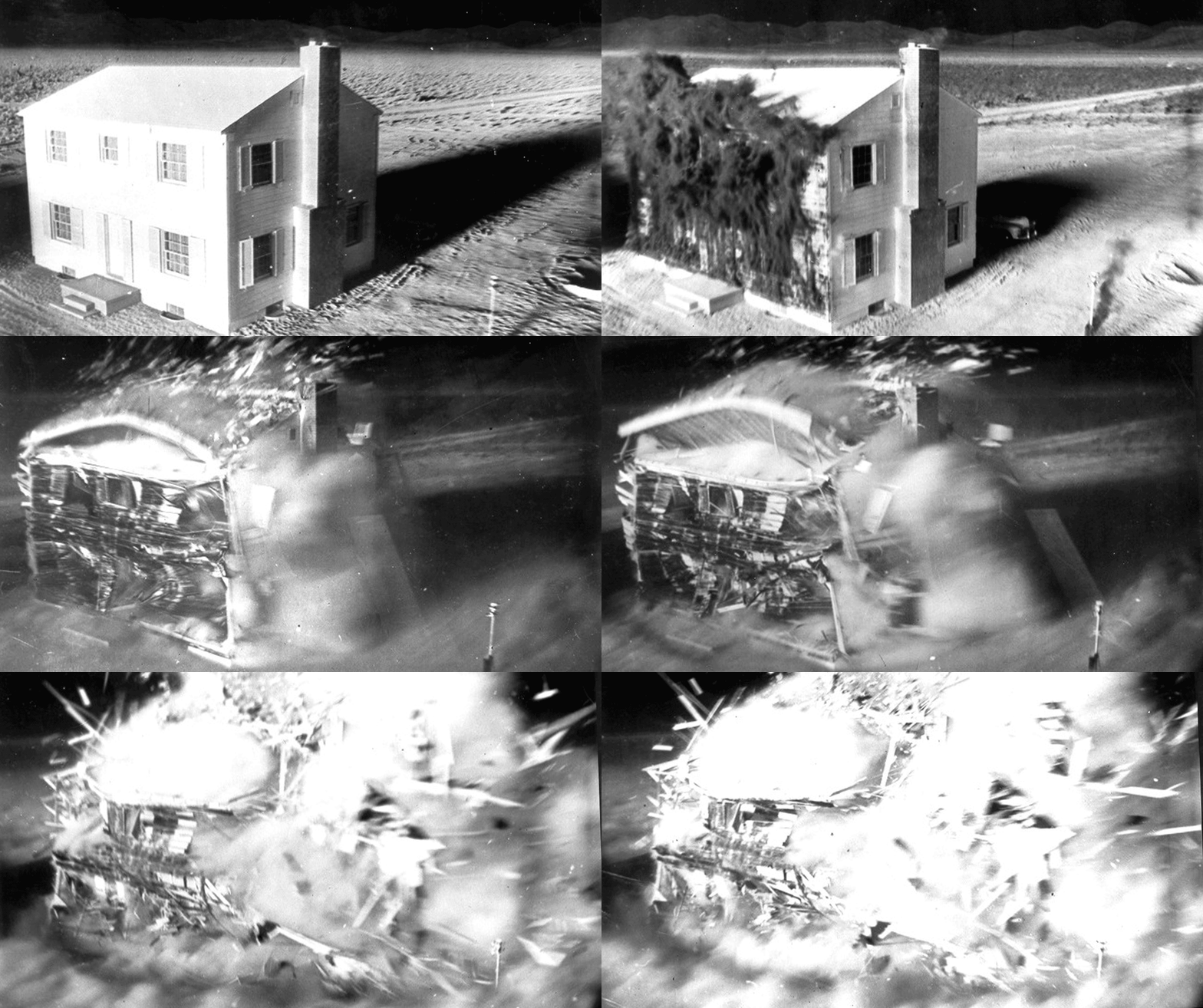
The below graphic shows the destruction of a test home by an atomic blast on March 17, 1953 at the Nevada Proving Ground. The structure was located 3,500 feet from ground zero, and the time from the first to last picture was 2.3 seconds. It shows the force of the blast wave then the radiating energy set it on fire.
Also, if a nuke is launched over our continent and explodes miles above the earth, it could create an electromagnetic pulse (EMP). An EMP is a split-second silent energy burst (like a stroke of lightning) that can fry electronics connected to wires or antennas like cell phones, cars, computers, TVs, etc. Unless electronics are grounded or hardened, an area or nation could experience anything from minor interference to crippled power, transportation, banking and communications systems.
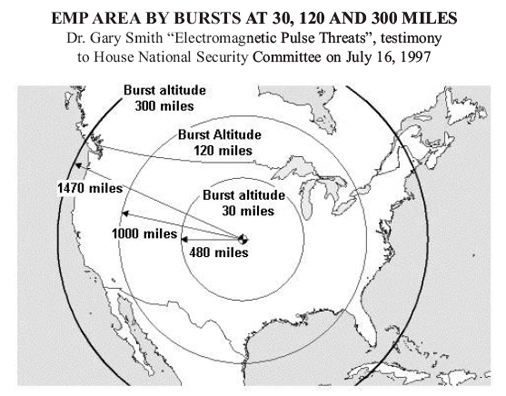
An EMP from a high-altitude nuke (where a nation or group succeeds in detonating a nuclear device carried miles into the atmosphere) could affect electronics within 1,000 miles or more as shown below. (Evidence suggests some countries and groups are working on enhanced and non-nuclear EMP weapons or e-bombs.)
What is the most dangerous part of a nuclear attack?
Both the initial nuclear radiation and residual nuclear radiation (also called radioactive fallout) are extremely dangerous.
Initial nuclear radiation is penetrating invisible rays that can be lethal in high levels.
Radioactive fallout (residual nuclear radiation) is created when the fireball vaporizes everything inside it (including dirt and water). Vaporized materials mix with radioactive materials in the updraft of air forming a mushroom cloud.
Fallout can be carried by winds for hundreds of miles and begin falling to the ground within minutes of the blast or take hours, days, weeks or even months to fall. The heaviest fallout would hit ground zero and areas downwind of that, and 80% of fallout would occur within 24 hours. Most fallout looks like grey sand or gritty ash and the radiation given off cannotbe seen, smelled, tasted or felt which is why it is so dangerous. But as the materials decay or spread out radiation levels will drop.
So how do I protect myself and my family?
Basic shelter requirements – Whether you build a shelter in advance or throw together an expedient last-minute shelter during a crisis, the area should protect you from radiation and support you for at least 2 weeks. Some basic requirements for a fallout shelter include …
- shielding
- ventilation
- water and food
- sanitation and first aid products
- radiation monitoring devices, KI (potassium iodide), radio, weapons, tools, etc
Reduce exposure – Protect yourself from radioactive fallout with …
- distance – the more distance between you and fallout particles, the better
- shielding – heavy, dense materials (like thick walls, earth, concrete, bricks, water and books) between you and fallout is best. Stay indoors or below ground. (Taking shelter in a basement or a facility below ground reduces exposure by 90%. Less than 4 inches of soil or earth can reduce the penetration of dangerous gamma rays by half.)
- time – most fallout loses its strength quickly. The more time that passes after the attack, the lower the danger.
Indoor shelter locations – If you don’t have a fallout shelter, these options could provide protection from dangerous radiation by using proper shielding materials.
- basement – find the corner that is most below ground level (the further underground the better)
- 1-story home / condo / apartment – if no underground facility, find a spot in center of home away from windows
- trailer home – find sturdier shelter if possible (like a basement or brick or concrete building)
- multi-story building or high-rise – go to center of the middle section of building (above 9th floor if possible). Note: if rooftop of a building next to you is on that same floor, move one floor up or down since radioactive fallout would accumulate on rooftops. Avoid first floor (if possible) since fallout will pile up on ground outside.
Shielding materials – All fallout shelters must provide good protection from radioactive particles. FEMA suggests having a minimum of several inches of concrete or 1 to 2 feet of earth as shielding around your shelter, if possible, and the more the better. Per FEMA, the following shows examples of shielding materials that equal the protection of 4 inches (10 cm) of concrete …
- 5 – 6 inches (12 – 15 cm) of bricks
- 6 inches (15 cm) of sand or gravel
- 7 inches (18 cm) of earth
- 8 inches (20 cm) of hollow concrete block
- 10 inches (25 cm) of water
- 14 inches (35 cm) of books or magazines
- 18 inches (46 cm) of wood
Make an expedient shelter – Some very basic ways to build an expedient last-minute shelter in your home, apartment or workplace to help protect you from dangerous radiation include…
- Set up a large, sturdy workbench or table in location you’ve chosen. If no table, make one by putting doors on top of boxes, appliances or furniture.
- Put as much shielding (e.g. furniture, file cabinets, appliances, boxes or pillowcases filled with dirt or sand, boxes of food, water or books, concrete blocks, bricks, etc.) all around sides and on top of table, but don’t put too much weight on tabletop or it could collapse. Add reinforcing supports, if needed.
- Leave a crawl space so everyone can get inside and block opening with shielding materials.
- Leave 2 small air spaces for ventilation (about 4-6″ each) – one low at one end and one high at other end. (This allows for better airflow since warm air rises.)
- Have water, radiation detection devices, KI, battery operated radio, food and sanitation supplies in case you have to shelter in place for days or weeks.
In summary, those within the blast zone of Ground Zero (depending on the size of the nuke) won’t make it .. BUT .. if you are a few miles outside the zone your chances of surviving it are high but you MUST have detection devices to monitor levels of radiation and a plan to stay sheltered for at least 48 hours or up to a few weeks. First Responders will have to wait for the deadly fallout to decay before they enter a hot zone so the more you prepare, the better your odds of surviving a nuke.


No comments:
Post a Comment